
Glitch'n AI
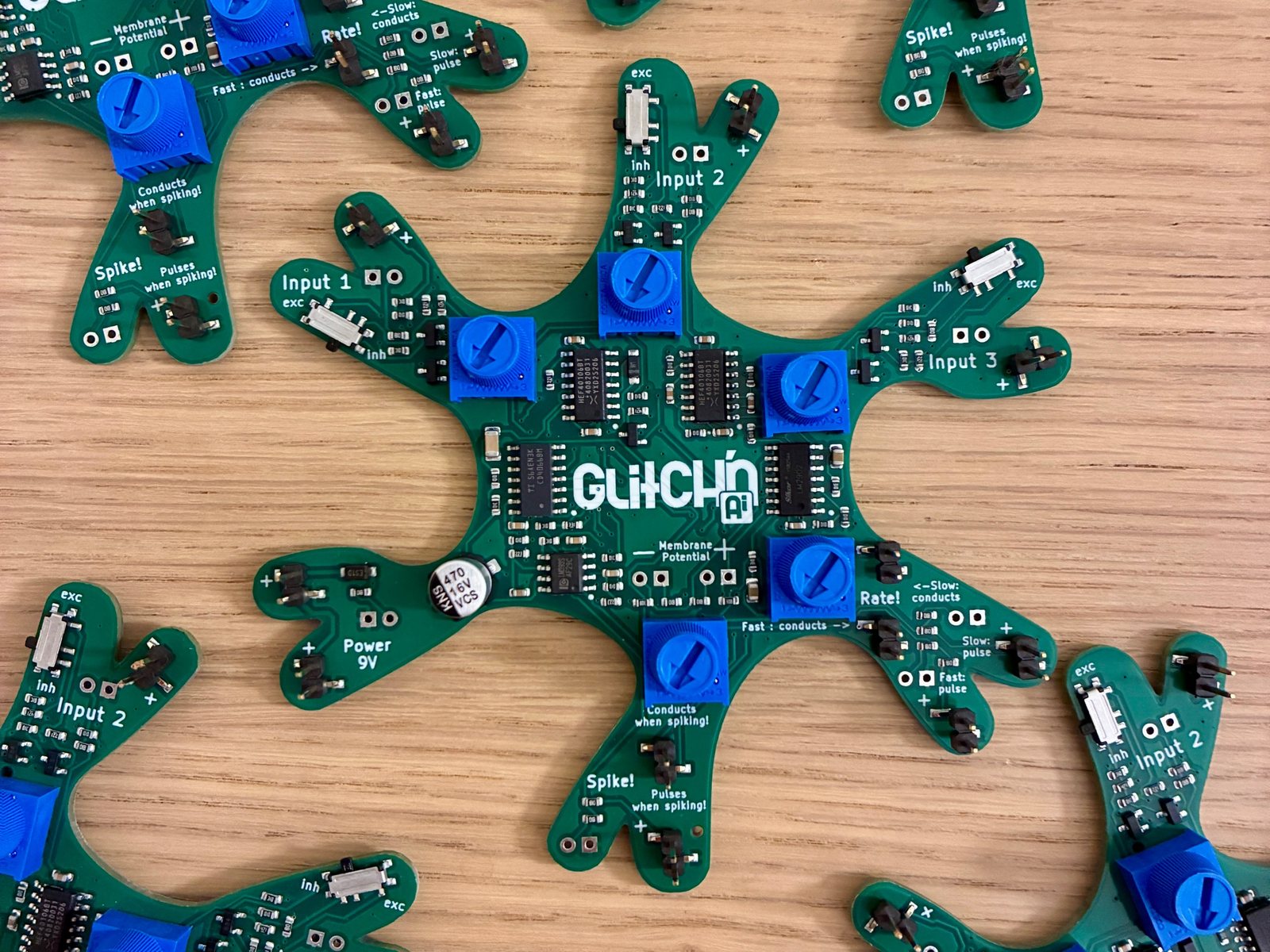
Glitch'n AI extends the Glitch'n circuit-bending course into AI literacy with the Glitch'n Neuron, a small neuromorphic module that turns students' circuits into spiking neurons they can hear and change.

Funded by an $8,000 prototyping grant, December 2025 to November 2026.
What it is
The Glitch'n Neuron connects directly to the logic circuits students already build and lets them change how a neuron listens and fires, in real time. The aim is neural computation students can hear, handle and modify, rather than something abstract or screen-based.
Building and testing
Glitch'n Teaching Fellows develop the Glitch'n Neuron through repeated prototypes, learning analog computing and board design along the way, and their work shapes a supplemental Glitch'n AI curriculum.
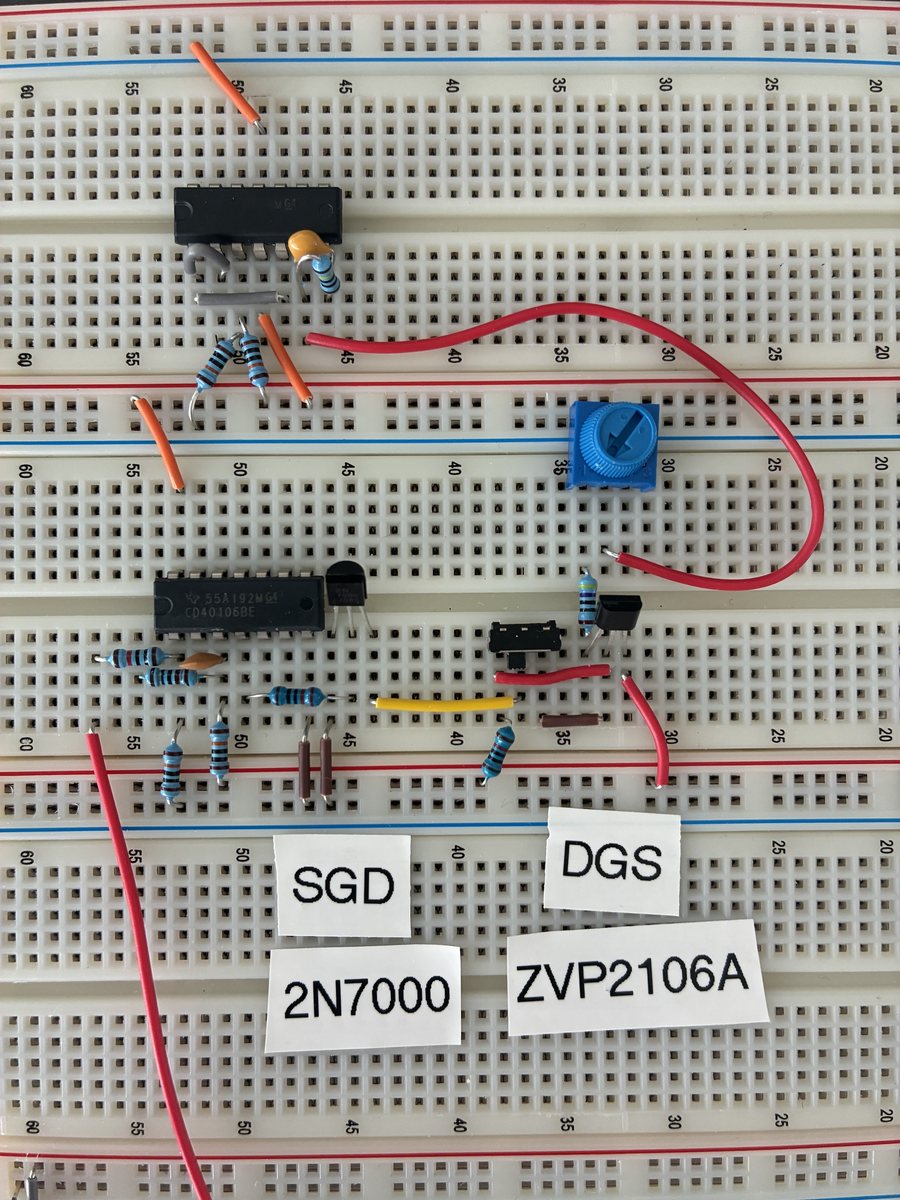
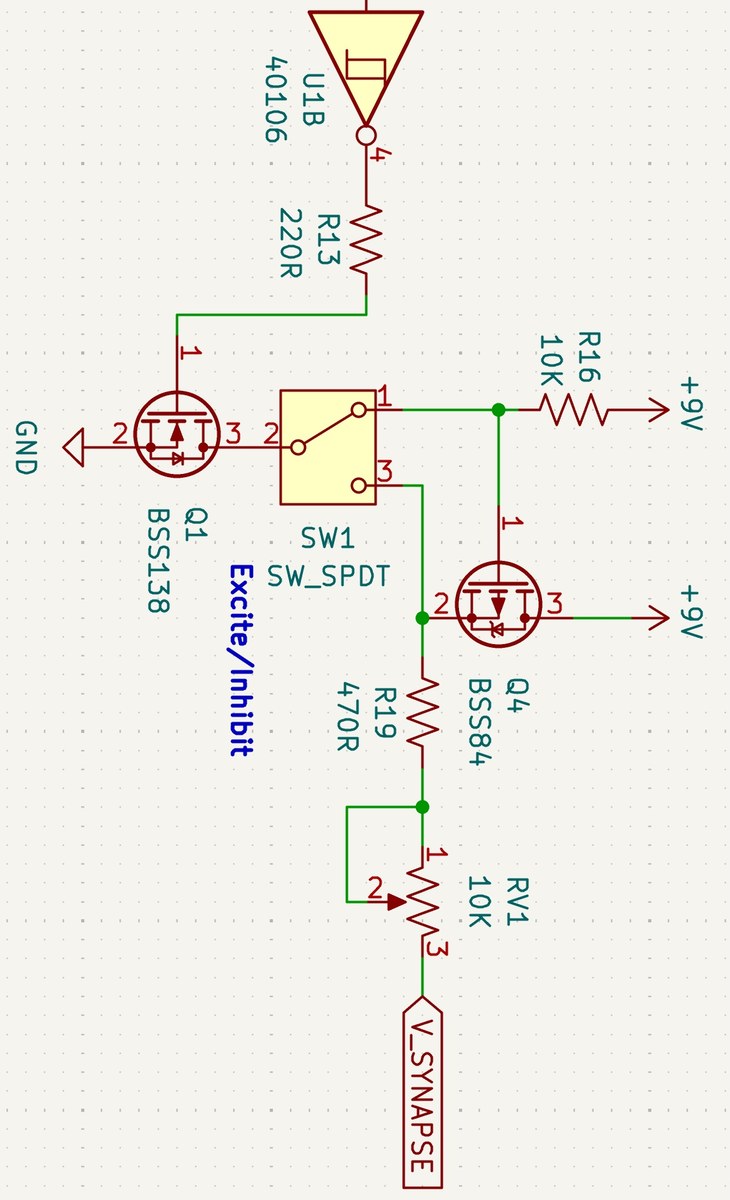
In weekly workshop sessions in early 2026, the team rebuilt the first boards on breadboards, soldered surface-mount chips onto adapters and tuned parts by ear (a 4.7 nF capacitor keeps the neuron rhythmic rather than squealing). Checking datasheets against the schematic, they found a MOSFET with its drain and source pins swapped, fixed the design and reordered the boards.
Ongoing development
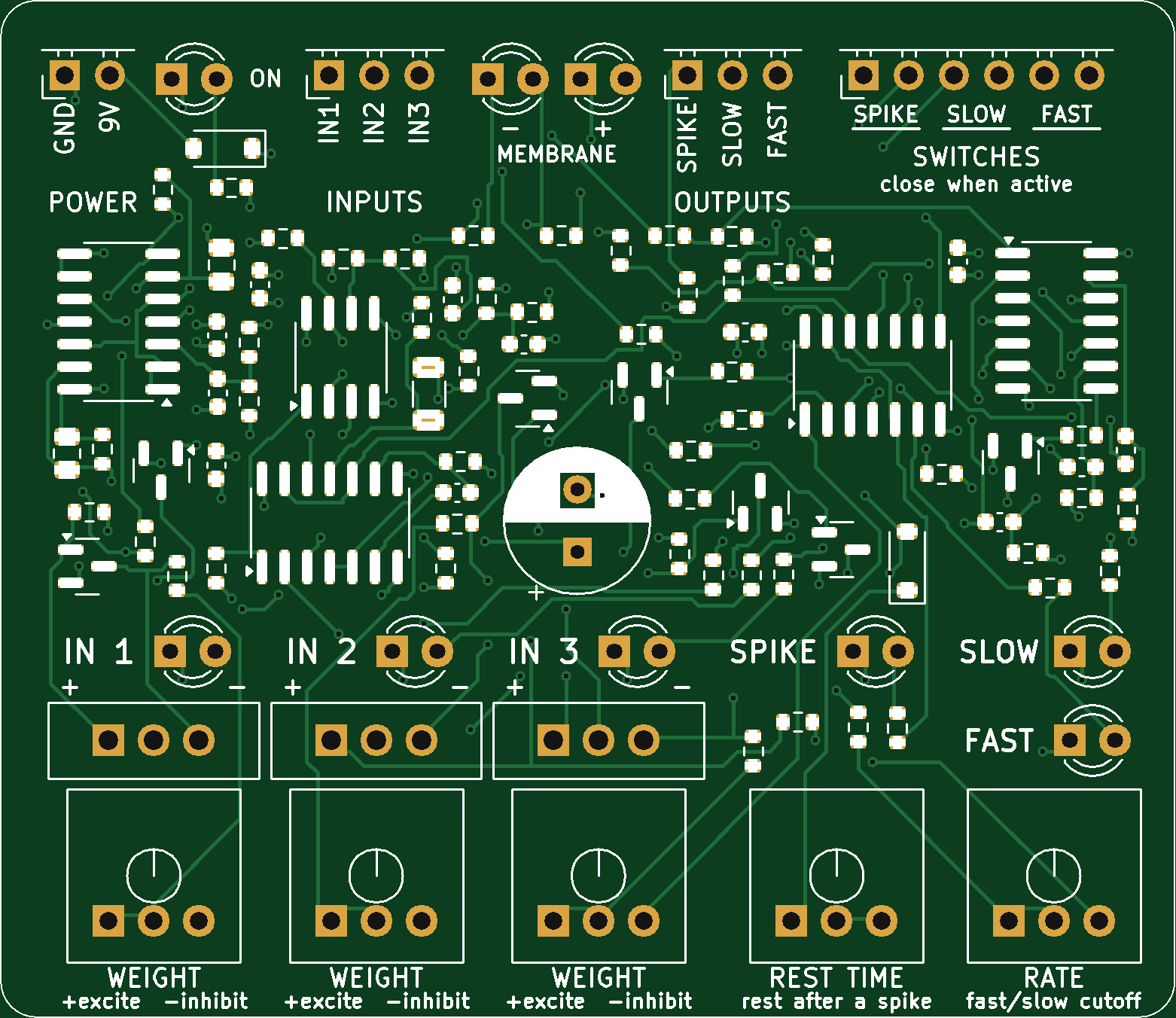
The neuron-shaped board looks the part, but its dendrites are awkward to wire to the half-size breadboards used in the course. The next prototype is a plain rectangle that sits flush below the breadboard, with pin headers along its top edge and knobs along the bottom: three inputs, each with a weight knob that runs from excite to inhibit, knobs for rest time and rate, and spike, slow and fast outputs. Wires stay short and out of the way of fingers on the knobs.
The Schmitt trigger
Every Glitch'n circuit starts with the 40106, a chip of six Schmitt triggers and a staple of handmade electronic music since Nicolas Collins's Handmade Electronic Music. A Schmitt trigger switches on when its input rises past one threshold and off only when it falls below a lower one. Add a resistor and a capacitor and it becomes the course's blinking, clicking oscillator.
Otto H. Schmitt invented the circuit in the 1930s as a graduate student, while working with the giant nerve axons of squid at the Marine Biological Laboratory in Woods Hole. He designed it to mimic how a nerve cell fires: the output holds steady until the input crosses a threshold, then switches cleanly, turning a smooth signal into an on/off one.* He published it in 1938 as “A Thermionic Trigger”; the original, a rack of vacuum tubes almost two meters tall, is held by the Bakken Museum in Minneapolis. Schmitt went on to help establish biomedical engineering and coined the word biomimetics for studying living systems by emulating them.
On the Glitch'n Neuron, Schmitt triggers turn signals from students' circuits into brief pulses that excite or inhibit the neuron, bringing the circuit back to where it started.
Otto H. Schmitt, An Electrical Theory of Nerve Impulse Propagation, PhD dissertation, Washington University in St. Louis, 1937; O. H. Schmitt, “A Thermionic Trigger,” Journal of Scientific Instruments 15 (1938); Pia van Gelder, “Histories of the Schmitt Trigger in Handmade Electronic Instruments for Making Sound in the Arts: A Literature Review,” NIME 2026.
Rooted in Glitch'n
Glitch'n AI keeps the course's emphasis on tinkering, glitch techniques and improvisation, guided by the HOMAGO framework. Students act as "peer auditors", trying each other's neurons and talking through what they hear.
Workshops
Workshops with CTRL alumni bring the Glitch'n Neuron into familiar Glitch'n circuits to explore spikes, timing and patterns. Students think aloud as they patch, listen and adjust circuits, so we can document how they explain their reasoning.
Anticipated outcomes
- New, hands-on ways for teens and young adults to explore AI concepts
- Teaching Fellows experienced in neuromorphic hardware, curriculum design and mentoring
- Curriculum that links CMOS logic, glitch practice and neural computation